
Christingle Service

Welcome here this morning to our Christingle Service, the origins of which go back to the Moravian Church in Germany in 1747.
In the Northern Hemisphere the weather cooperates with the liturgy. Advent is a time of darkness and cold. Liturgy doesn’t just talk about the weather, but it uses ‘dark’ and ‘cold’ to point to the suffering in the world: grief, loneliness, poverty, war… All these things and more were the ‘dark’ and ‘cold’ of the night before Christmas.
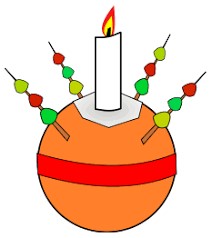
Then at a Christingle service along comes an orange. Don’t ask me why it’s not an apple; but it’s an orange. This represents the world, planet Earth. And around its circumference is a bright ribbon, symbolizing God’s love. God’s love wraps itself around the world. Held in place by a pin. (I don’t think the pin symbolizes anything). Then there are 4 toothpicks stuck into the orange. (They too aren’t symbolic of anything). But on the toothpicks are colourful lollies. These lollies (Liquorice Allsorts are the best) represent the four seasons of the year. (Although on a Christingle all the lollies look bright and beautiful ,not just the summer and spring ones). And lastly, and most importantly, there is the candle stuck in the top, which is lit at the end of the service.
This candle represents Jesus coming as the ‘light of the world.’ That is through Jesus’ way of loving and including, and his followers’ ways of loving and including, the ‘dark’, ‘cold’, and ‘suffering’ would not only find relief but would be restored into a community of belonging and purpose, a community of light.
So Jesus is the candle, the light, but so too are we to be candles and lights to others, and a community of light.
+++
The story I have for you this morning is “Light the Lamps” [i]by Margaret Wild and Dee Huxley. It’s a different type of story than most children’s Christmas stories. For most Christmas stories are joyous and jingly, with gifts given or anticipated, with generosity and kindness encouraged. Sometimes there’s Santa, or a Christmas Pageant, or a talking animal or two.
“Light the Lamps” is more of an Advent story, set in a context of what I said earlier about ‘dark’ and ‘cold,’ when we hope for light but it hasn’t arrived. And, unlike Advent and Christmas, this book has Jesus as a toddler (I guess a2-year-old).
The ‘dark’ and ‘cold’ of “Light the Lamps” is about pain, rejection, and longing. And the ‘light’ is acceptance and inclusion.
The story is told by a young girl who is being brought up by her step-parents. Her step-mother hasn’t been able to give birth to children and the pain of that is ever-present. There are many women who know that pain, and the story invites us to be understanding, empathetic, and kind.
This pain is symbolized in a little carved camel that the step-mother has kept for the hoped-for child of her womb - a gift to give her baby after its birth.
There is pain too for the young girl, who longs to be full accepted by her step-mother. She’d love a little carved camel too.
The context of the story is Palestine, more specifically Nazareth, in the first century CE. For the young girl has befriended Mary, Joseph, and their toddler Jesus; and gets a lot of joy out of playing with Jesus. Indeed in playing with him she feels, despite her experiences to the contrary, that the world is good place and all shall be well. Young children can do that to us too.
The young girl wants her step-mother to experience this feeling that the world is good place and all shall be well too, and meet the toddler Jesus. But it is too difficult, too painful, for her step-mother.
One day however, as chance would have it, the young girl and her step-mother happen to meet Mary and Jesus at the market, and before she knows it, they are at Mary’s house, and a sleeping child is placed in the step-mother’s arms.
When they return home the step-mother gives the girl a shaky smile and a hug. She fetches the little camel and puts it in her hand. And then she lights every lamp in the house.
Apart from a chance meeting in the market there is no ‘deus ex machina’ in this story, no magical angel or Santa coming down to make everything ok. Instead there is pain and struggle, and finally some acceptance and sense (for the girl, and maybe too for her step-mum) of deeper belonging. Christmas with its emphasis on babies and families can be very hard on some people.
Through the power of persistence (think of the actions of the girl), the power of physical touch (both for the girl and her step-mum), and the power of friendship (with Jesus and Mary), some healing comes for both the girl and her step-mother.
To believe in Jesus is to believe that every child is a holy child.
To believe in Jesus is to believe that the human race can transform into the human family.
To believe in Jesus is to believe we can be transformers – bringing the light of hope – by being tenacious, and kind, and not afraid.
The story concludes with lighting lamps in the house – symbolizing light driving out the darkness of rejection and pain; symbolizing hope of a new tomorrow –travelling with the sorrow but not overwhelmed by it, travelling together in sorrow and hope rather than being and feeling alone.
[i] M. Wild & D. Huxley Light the Lamps, Sydney : Margaret Hamilton, 1994.

.jpg)
