
Epiphany I. The Magi

I thought I would offer a little in the way explanatory notes about the St Luke’s liturgy as I realize it is quite different from other churches. The gift of five congregations joining together as a region, as we do in January, is to experience some of liturgical riches we each have.
Firstly, the Voluntaries that start and end our services at St Luke’s. These are not background mood music as we enter and leave, nor are they performances where the organist shows their skill. Rather, like a Buddhist prayer bell, this music is help centre us, leave aside the busy clutter of worries and demands, and try to be still, opening our heart to God – who is in all, through all, among, between, and more.
Secondly, the Peace (Te Maungārongo). This comes towards the beginning of our service. It is not merely an opportunity to turn and greet your neighbour, or greet someone new. Nor is it a time to ‘make peace’ with someone you have wronged or has wronged you. These things of course are important, but this is not what this part of the liturgy is about.
Rather the Peace is saying that through God-in-Christ all barriers that divide people from each other have been overcome. When we clasp hands, hug, or bow to one another, we are recognising the divine that is in that other person, they are of God, and God’s beloved.
Usually we greet just those around us as representative of all those in the building. In greeting a few we are symbolizing that we are greeting all.
It’s important for people who are visiting or who find groups of people unsettling, to only participate to the extent they want to. We need to respect the degree of physical touch that each person considers appropriate. If unsure, ask.
The Peace also holds before us a vision of peace. Different from each other, we can come together. Disagreeing with each other, we can be together. Diverse and divergent we may be, but the more fundamental truth is that we are all embraced, recognized, and belong in the heart of God.
Thirdly, I’d like to draw your attention to the Affirmation of Faith (He TikangaWhakapono). This is not a belonging statement, nor one loaded for doctrine, like the authorised affirmations of General Assembly. This affirmation doesn’t ask you to agree with it (and please if there is a line or two you can’t say, then don’t). It is simply one attempt to express some of the things important to the practice of our faith in the world; what faith might look like outside the doors of a church.
Fourthly, language for God. All such language is poetic attempts to express the inexpressible mystery and wonder we call God. And all such language is provisional, a product of its time. So in our liturgy you’ll find language for God you’re familiar with and some you’re not. In the old hymns, like we’ve just sung, you’ll find God referred to as ‘Lord’ and ‘King’ (words that today struggle to escape their feudal patriarchal lineage). You’ll find some prayers with no God word in them, like the old Celtic prayer: “May the blessing of light be upon you.” And you’ll find words you might not thought of as a name for God before, like in the Jesus prayer (following the intercessions) which addresses God as ‘Creative and Kin’ (rather than Creator and Father/Mother).
And lastly the Blessing (Te Manaakitanga). In olden times, and in many churches today, the Blessing is understood as God blessing us through the intermediary of a priest or minister. Presbyterianism doesn’t hold to that understanding. God works through each of us to bless one another, no matter how holy or not we feel or are.
This blessing today, like others we use at St Luke’s, invites us to open our eyes to notice God all around and within, touching us with beauty, grace and hope, eliciting in us a deep thankfulness, and provoking us to join in being builders, weavers, makers of more beauty, grace, and hope. So when we all respond with the sung ‘Amen,’ we are both affirming our gratitude for the good we see and know, and our commitment to help make more of it.
+++++++++++++++++++
The Children’s Story today is Alan McDonald’s “The Not-So-Wise Man.” Ashtar (aka the not-so-wise man)thinks wisdom is found in traveling light, traveling alone, refraining from socializing, and putting up signs like ‘No Room’ in order to get some peace(but missing the Prince of Peace lol). Ashtar also thinks that a king couldn’t be born in a barn. Whereas, the author McDonald, using the medium of humour is affirming the opposite, or rather than wisdom is always both/and.
So McDonald’s story tells us:
- Wisdom is learnt from and with others, in company, in communion.
- Wisdom is found among unlikely people, so barriers to keep strangers and their needs away (like ‘no room’ signs) might be keeping wisdom (even God) away.
- Wisdom can be something found unexpectedly in places we hadn’t thought of.
- Wisdom is about being open to the nudgings and surprises of God.
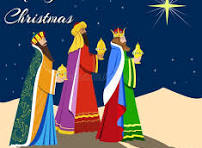
Note the pictures in McDonald’s book owe more to the likes of Henry Wadsworth Longfellow (his 1870s poem The Three Kings) than anything remotely historical. Note the screen image today from the 4th century of the Magi. Not that I’m saying that’s an accurate portrayal either.
+++++++++++++++++++++
The story of the Magi, one we are all familiar with, of which poems, tales, and children’s books abound, should remain outside the constraints of popular history. For when earnest factfinders go looking for astronomical oddities that might explain the star, or evidence that three wise men (or were they kings?) came riding on camels… they have taken a road to nowhere.
By the way, fun facts, the Bible text does not mention ‘three’ or ‘wise’ or ‘men’ or ‘camels’. What it does say is Magi. Also known as Zoroastrians. An ancient faith that is still practiced today. Not Jewish. Not Christian. And that’s another fun fact: the text says nothing about these Magi converting to Judaism or what anachronistically could be called Christianity. Note, it is possible that the writer of our text was using the term Magi more broadly as ‘seer. What is universally agreed on though is they were foreigners.
But the story of the Magi should remain outside of thinking ‘facts’ and ‘did it and how did it happen’, and instead continue, as I believe it always has, to mythically challenge us, you and I, to go on a journey ourselves, crossing boundaries, maybe for us too of faith, culture, and comfort, to follow a ‘star’ (one others often can’t see, but twinkles in our hearts), avoiding the machinations of those who only see with the lens of power, control, and violence, to find hope in the most unlikely, unsanitary and unsafe of places, among the most unlikely of people. And there, at the stable of our discomfort and discombobulation, obey our hearts, bend our knees in the knowledge that we ultimately know nothing, and offer what we have and are – our ‘worship’.
The first reading (Te Panui Tahi) today is the well-known poem by Robert Frost, published in 1915 when Europe was engulfed in World War I; the United States would enter the war a year later. While often interpreted as a celebration of individual choice (as M. Scott Peck does), the poem is actually a subtle, self-deprecating look at how people rationalize choices, suggesting the paths were nearly identical and the “difference” is a story told later. Kind of like how war gets talked about afterwards.
The two paths that are met in the woods, look remarkedly similar. Save that one path at first shows signs of wear, being travelled more often. But the speaker then revises this: “they had worn really about the same.” The decision therefore was based on an impulse, a hunch, an intuitive leaning.
Maybe, in this light, we might consider that it all began for the Magi with a hunch. A nudge. From their intuition. Then, “way leads onto to way.” Sometimes taking a wrong turn, like visiting Herod, sometimes taking a right turn, like the stables out back. Journeying on.
Christine Paintner, in reflecting on the Magi tale, offers seven spiritual guiding stars (a Pleiades):
Firstly, follow the hunch in your heart. As you stand under a dark sky of unknowing, which star is shimmering? Which direction is your heart nudging you in?
Secondly, embark on the journey, however long or difficult. The character Herod gathers all his chief priests and scribes to find out more about this holy birth. Instead of searching out for himself, he sends the Magi on his behalf. Whereas the Magi make the journey for themselves.
Third. Open yourself to wonder along the way. The scriptures tell us the Magi were "overjoyed at seeing the star." I like to imagine them practicing this kind of divine wonderment all along the journey. This wonderment resonates with the poetic words from the Wisdom of Solomon (18:14-15) “For while gentle silence enveloped all things, and night in its swift course was half spent, thy all-powerful Love leaped from heaven, from the royal throne.”
Fourth. Sometimes we meet holiness where all reason, all conditioning and teaching, tells us it shouldn’t be. When the Magi enter the stinky, muddy manger, the text says they bow down and prostrate themselves. Prostration is an act of humility and honour, as well as full-body connection with the earth.
Fifth. Travel light. Possessions we cling to can weigh us down. When we are confronted by a need, or simply a desire to give, then surrender to that need or desire. Gold, frankincense, and myrrh - symbols of sovereignty, supplication, and suffering -may not be what we have in our kete. Yet we may have something even more precious (not that it’s a competition) to let go of. It is the letting go, along with the full-body connection with the earth, that is the ‘worship.’
Sixth. Keep listening to the wisdom of dreams, the wisdom of your intuition. The Magi are warned in a dream not to return to Herod, and they pay heed to this night wisdom.
Lastly, after receiving the gift of the dream, the Magi choose another way home. In truth, after any journey of significance, there is no going back the same way as before. We always return with new awareness.
I close with Longfellow’s delightful opening verse. A tribute to the ongoing mythos the Magi have evoked. Note, for equestrian lovers, his ‘kings’ rode horses (not camels):
Three Kings came riding from far away,
Melchior and Gaspar and Baltasar;
Three Wise Men out of the East were they,
And they travelled by night and they slept by day,
For their guide was a beautiful, wonderful star.

.jpg)
