
Trinity: Jesus, God, and Perichoresis

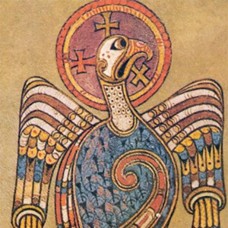
This is a reflection about the theological construct called the Trinity. I’m going to start with Jesus, and the implications of Jesus’ teaching and actions for understanding God. Which in turn affects how we understand the Spirit, aka the Spirit of God, the Spirit of Jesus, the Holy Spirit, and for the Celts the Wild Goose.
Then I’m going to make a quick comment on the post-biblical debate, which I think is about seeing God primarily as command and control or otherwise primarily as cooperation and community. If you try to make God both you lose completely what Jesus was on about.
Lastly, and this will be in the second half of the reflection I want to read you a slightly adapted rendition of a poem titled “The Gospel of the Wild Goose” which picks up some of the themes I will be talking about.
So, to Jesus. Jesus was chiefly a disrupter of God. Of how people saw God. Of how the tradition/theology at the time saw God.
Jesus over the centuries has had many names draped around his shoulders. Some of the more recent, in our lifetimes, have been “the man/person for others”, “liberator”, “the cosmic Christ”, “Sophia/wisdom”, “the Teacher”. All of which hold some truth. Yet, I would argue he started with deconstruction (disruption)as a prerequisite for reconstruction (reimagining).
Our first reading includes a short, coded parable found in the gospels of Luke, Matthew, and Thomas. The context is about God and about Empire.
Firstly, God. In Judaism (indeed in most religion) God is holy, scared, and clean. And humans, by deed, biology, or nature, are not. So, religions create cleansing rituals, like washing, eating the right foods, repenting, etc. These rituals are so we can become holy, acceptable, clean in the sight of God.
Secondly, Empire. Empires, like Rome, are predicated on the notion that some are better than others. By birth. By class, gender, and religion. And the so-called better, or higher, ones are destined to rule, and the lower, lesser ones to be ruled.
The notion of holiness or cleanliness is corelated. The unclean are the lower ones who, if care isn’t taken, can pollute the higher ones. So, for example, women can pollute men, the poor can pollute the non-poor. The higher ones are acceptable to the gods, and their power over others is ipso facto evidence of that. The lower classes are unacceptable, powerless, and ipso facto unacceptable to gods.
Therefore coming to our little parable, we need to bear in mind that cleanliness, God, and politics are all intertwined.
To read the code: Firstly, leaven. It’s a bad thing. Think bacteria. Think rotting meat. Leaven is code for unholy, sinful, and polluted. So, its unleavened bread that is clean.
Secondly, the actor, the only actor, is a woman. By gender one of the lower lesser ones. By nature and biology deemed to be unclean. Not a hero. Not a saint. Not asomebody, but a nameless nobody.
Thirdly, three measures of flour. This is the quantity of flour that the great patriarch Abraham ordered Sarah to make into bread for his divine visitors. And Gideon similarly. And the quantity mentioned in the Hannah/Samuel story, and in the Ezekiel story. ‘Three measures’ has a holy ring about it. (It is also a lot off lour – 22 kgs).
So, the story is simple. An unclean nobody (the woman) audaciously and secretly pollutes the holy/godly flour. In other words, the woman subverts the holy, making the clean unclean.
And the parable says this is what God’s empire, God’s politics, is like: the lowly ones using their agency to subvert holiness, subverting the order of who and what is clean and unclean, subverting the existing hierarchies’ understandings of order and power. Thus, the parable says God’s empire is unclean, and provocatively, God is unclean. (God, like us, in this world’s understanding, can’t be both).
I’ve used this parable, and there are many other parables and sayings, as well as interactions and healings, that underline how Jesus was disruptive not only of the religious status quo but of the foundation of religion, namely God. For God was understood primarily as the paramount power behind all earthly power, the one who ordained men to be superior to women, who ordered the first superior to the last, the adult to the child, the freeborn to the slave, and Roman superior to all other races. And Jesus said otherwise.
And the disrupter, not surprisingly, was executed for sedition. The cross was a commoner’s execution.
Then, the early post-Easter movement, had a problem. On the one hand you had the God of convention who was highest of the high, holy and sovereign, and you had Jesus, the crucified low-born loser, who mixed with the unclean and in turn was polluted. On the other hand, you had the conundrum of, as John’s community would say, ‘if you have seen Jesus, you have seen God’. Jesus was the window into God.
This conundrum was then wrestled with over centuries, and still is today. Some churches still want to think of God as the supreme ruler lording it over all, and (disregarding most of what he said and did) make Jesus into a prince orco-king, albeit a kindly one. This was the religion most of us knew in childhood.
For if Jesus is a subversive, and God (following John) is likewise a subversive, then the way we view power and empires and class and race… would all be thrown into disarray.
As for the Spirit, I think the Bible gives scant evidence for trinitarianism. The prayer we know of as ‘The Grace’ from 2 Corinthians is one of only two texts, and could be interpreted simply as the spirit, known in Jesus, carrying on after his death building community and communion, a community and communion that embodies that subversive praxis of Jesus.
In the readings today I included a quote from Ezra Klein about cooperation. This is the soft power that makes a community a community. Cooperation relies on building goodwill, exercising empathy, and finding joy in being and working together. And if power is what lasts, then cooperation is very powerful.
And also in the readings, with the help of AI, I included a brief synthesis ofwhat’s called the Social Trinity. Some would argue, quite convincingly I think, that the 4th century Cappadocian Fathers and Mother, who developedthe theology of the Trinity, leaned more towards an understanding of divinity as being less about command and control, and more about cooperation andcommunity. Perichoresis is a word pointing to relational mutuality and a cooperative non-hierarchical community.
The Social Trinity can then in this sense be seen as potentially subversive of understandings of empire. The holy threesome would not be wearing golden copes but common cloth, not crowns of jewels but crowns of solidarity with the suffering. Needless to say, in those 4th century days of Christendom and Christian Emperors such a portrayal of divinity was dangerous. Not that the Cappadocians spelt it out in the terms I’ve used.
++++++++++++++
Jon Swales, priest and poet, located in Leeds, England, runs a blog called Cruciform justice. In the poem I’ll read shortly, called Gospel of the Wild Goose, he points to the work of God Holy Spirit in disrupting us, being out of control (out of the control of the controllers), in this sense being anarchical. And forming communities and churches of the crucified loser, provoking the cooperation and trust symbolized in communion, holding the diversity of humanity where unclean and clean, saint and sinner, are no longer demarcations and barriers, but have always been dissolved in God. This God Holy Spirt is still calling to us, offering to be a willing companion, a wild soul friend and inspiration. (Ruach is a Hebrew word translated as spirit or wind)
Hereis
the holy breath —
Ruach,
wind unleashed,
fireunfenced,
birth without borders.
She,
the Wild Goose,
cannot be caged by pulpits,
or penned in by programmes.
She dances in streets,
whispers in prison cells,
weeps at injustice,
comforts mourning,
breaks boardroom silence,
breathes where none expect.
The Wild Spirit
forms us —
church and soul —
into the wild shape
of the crucified loser,
cruciform love
carved in flesh and fire.
She rides the storm —
climate collapse,
societal unravelling —
tearing down idols:
consumer gods,
untrained capitalism’s lie.
She teaches us to swim
against the tide,
to bear the cross
and rise
in every fracture.
The Wild Spirit
does not build empires,
she topples them.
She sells no tickets,
tears the veil.
She preserves no comfort,
provokes communion.
Here is the Church,
huddled, locked,
minds fogged,
and suddenly —
the Spirit bursts in:
wind that will not be tamed,
flame that will not be snuffed,
holy unrest that won’t be silenced.
Let the Church be this:
less script,
more surrender.
Less franchise,
more fierce faith.
Here is the street preacher,
untrained,untamed,
ablaze with Gospel fire
that will not hush.
Proclaiming a crucified weakling —
thousands hear hope’s own language.
Let the Church be this:
many tongues,
not to boast,
but to bless.
Here is Lydia,
business leader,
sanctuary-maker,
her table an altar,
a new community planted
by Spirit’s hand.
Lett he Church be this:
hospitable,
resourceful,
courageous
to create new space.
Here are apostles,
chains heavy,
worship loud,
foundations trembling.
Chains fall,
but they stay —
for liberation is not escape,
but presence.
Let the Church be this:
singing in darkness,
speaking truth to beasts,
choosingsolidarity
over self-preservation.
Here is a riot,
market raging,
Gospel and greed
cannot share one table.
Yet Spirit moves
through upheaval,
birthing new worlds.
Let the Church be this:
disruptive compassion,
gentle resistance,
fearless hope.
The Spirit is no commodity —
not a thing to own,
but Companion,
leading us into unknown.
Advocate,
Breath of Life,
Mother of the marginalised,
wild as creation’s first cry.
Even now,
she sends.
Even now,
she breathes.
Even now,
she equips the wounded Church
to carry the crucified loser,
to embody cruciform love,
to carry the wild Messiah’s fire
into forgotten streets,
to swim upstream
against empire and empty gods.
Lett he Church be this:
Spirit-shaped,
fire-tinged,
risk-taking,
margin-walking,
wounded,wild,
and faithful
Amen,
and amen again.

.jpg)
